

The science of memorable events: Why storytelling is becoming essential in incentive travel?
What makes people remember an event years after it has ended? It is rarely the conference room, the dinner menu or even the destination itself. Research from cognitive psychology, neuroscience and destination marketing increasingly suggests that lasting memories are created when experiences are organised into stories. As expectations towards corporate events continue to evolve, storytelling is becoming far more than a creative layer—it is emerging as one of the most effective tools for creating engagement, strengthening emotional connections and revealing the true character of a destination.
Our brains remember stories, not itineraries
Human memory is remarkably selective. Every day we process an enormous amount of information, yet only a small fraction is retained over the long term. One of the reasons lies in the way our brains organise experiences. Rather than storing isolated facts, we naturally arrange information into narratives that provide context, causality and emotional meaning.
Neuroscientific research has shown that stories activate significantly more areas of the brain than factual communication alone. Alongside language-processing centres, narratives engage regions responsible for emotion, sensory perception and autobiographical memory, resulting in deeper cognitive processing and stronger recall. In other words, a well-told story does not simply communicate information more effectively—it becomes part of our own experience. For the meetings and incentive industry, this has important consequences.
If the objective is for participants to remember a destination, a company message or a shared experience months or even years later, storytelling is not merely an engaging presentation technique; it is one of the most powerful memory-building tools available.

A well-told story does not simply communicate information more effectively — it becomes part of our own experience.
Emotion transforms experiences into memories
Memory researchers have long argued that emotion is one of the strongest predictors of long-term recall. We rarely remember an event because it was efficiently organised; we remember it because something surprised us, challenged our expectations or made us feel connected to the people around us.
Neuroscientist Paul Zak’s research suggests that compelling stories stimulate the release of oxytocin, a neurochemical associated with empathy, trust and social bonding.
While flawless logistics create comfort, stories create emotional investment—and emotional investment is what participants ultimately remember.
A perfectly organised gala dinner may satisfy expectations, but it is unlikely to become a story people continue to tell. Walking through Budapest’s historic coffee houses while discovering how writers, revolutionaries and artists shaped Hungarian identity, or uncovering hidden Cold War locations through the eyes of local historians, creates an entirely different kind of experience. Participants are no longer passive observers; they become active participants in a narrative.
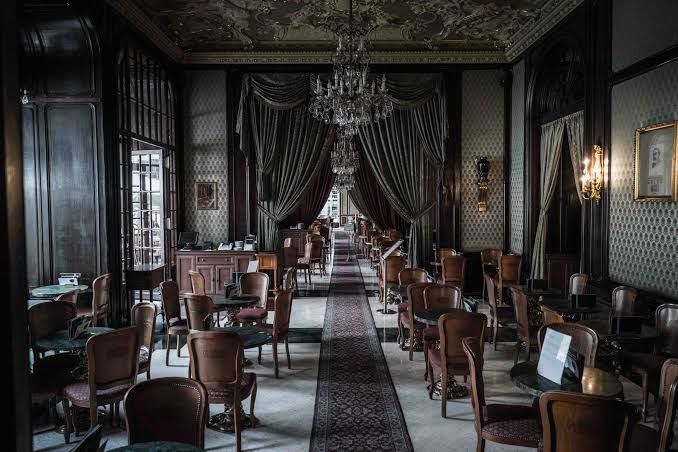
Café Gerbeaud Budapest
Destinations are increasingly competing through meaning
Cities across Europe offer exceptional hotels, renowned gastronomy, impressive architecture and efficient infrastructure. These elements have become the baseline rather than the differentiator.
Increasingly, destinations distinguish themselves through interpretation rather than attractions alone. A building becomes memorable not because it is beautiful, but because visitors understand what happened there. A neighbourhood becomes meaningful when its stories reveal the people, conflicts and cultural movements that shaped it. The physical environment remains the same, but narrative fundamentally changes how visitors perceive it.
Authenticity, local perspectives and cultural immersion have become increasingly important drivers of visitor satisfaction. Particularly in the premium incentive market, travellers are seeking access to experiences that cannot be easily replicated elsewhere or discovered independently.
From sightseeing to storyliving
Traditional city tours often present landmarks in chronological order. Story-driven experiences take a fundamentally different approach. Instead of asking What should visitors see?, they ask What journey should visitors experience?
This subtle shift transforms the participant’s role. Rather than consuming information, guests begin solving mysteries, following historical characters, understanding cultural turning points or exploring the city through a specific theme. The destination becomes the setting of a narrative rather than the subject of a guided tour.
This approach reflects a broader evolution within experiential design. Today’s delegates increasingly value curiosity over completeness. They do not necessarily want to see every landmark; they want to understand the stories that give those places meaning.

Why Budapest is uniquely suited to storytelling
Few European capitals offer such a dense concentration of overlapping narratives as Budapest. Within a relatively compact city centre, centuries of history intersect with literature, architecture, espionage, political transformation, café culture, music, Jewish heritage and contemporary creative communities.
These stories are not confined to museums or history books. They remain embedded within the streets, buildings and neighbourhoods themselves. The city can be explored through the rise and fall of empires, the lives of its artists, hidden crime stories, the formation of Hungarian identity, or the remarkable resilience that has repeatedly shaped Budapest’s character.
For event organisers, this creates opportunities that extend well beyond traditional sightseeing. A destination can reinforce conference themes, encourage reflection, stimulate conversation and create emotional connections simply through the narratives chosen to frame the experience.
At HighVibes Budapest, we believe the most memorable events begin with a narrative, not an itinerary. Whether your objective is to inspire, reward or bring people together, we design experiences that reveal Budapest through the stories that have shaped it—stories of artists, revolutionaries, innovators, hidden neighbourhoods and unexpected local perspectives.
If you’re looking for an incentive programme or corporate event that your guests will still be talking about long after they return home, we’d love to help you discover a different side of Budapest.